
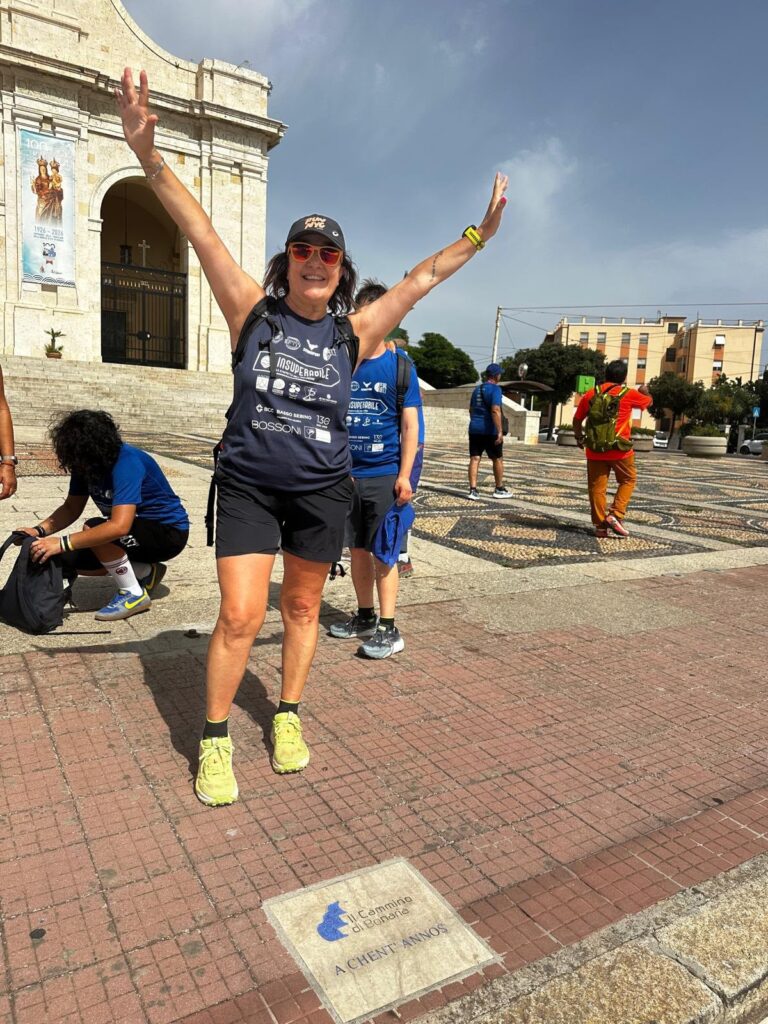
For me, the Bonaria Trail wasn’t just a journey to complete. It was a different way to explore Sardinia, to get to know the region, and, above all, to meet its people.
I experienced it as a person with a disability, as an athlete, as President of ASD Se Vuoi Puoi, and also as a lawyer. Different roles that continually intertwined along the Way.
What I’ll take with me, above all, is the warmth of Sardinia. At every stop, we met volunteers, organizations, local governments, and people who made us feel truly welcome. It wasn’t just superficial hospitality, but genuine kindness—marked by care, generosity, and humanity. When you’re covering so many kilometers, fatigue is inevitable and you feel it, but knowing that someone is waiting for you, welcoming you, and sharing even just a small part of your journey completely changes the meaning of the trip.
Our project also had a specific goal: to talk about disability through people’s experiences, not just through words. We traveled through Sardinia together—people with different disabilities, volunteers, and guides—demonstrating every day that inclusion means, above all, creating the conditions so that everyone can be present, participate, and contribute according to their own abilities.
For me, this had an even more personal significance. For years, I’ve been trying to share my story of multiple sclerosis and bring to light what often remains invisible. On the Camino, I did this simply by walking, cycling, meeting people, and sharing my story.
There is, however, one stage that took on special significance for me: the visit to the Quartucciu Juvenile Detention Center.
The fact that the Bonaria Pilgrimage chose to leave one of its stones even inside a juvenile detention center is an image I find deeply meaningful.
As a lawyer, upon entering that place, I couldn’t help but view it through the lens of my profession. But I was also there as a pilgrim. And it was precisely the convergence of these two perspectives that struck me.
A journey is movement. It means starting from a point, overcoming difficulties, stopping when necessary, and then continuing on the path. Above all, it means being able to envision a destination.
Symbolically bringing the Pilgrimage into a place where young people are going through a difficult phase of their lives means reminding them that even from there, there must be a path toward a different future.
Punishment, especially when it involves a minor, cannot be merely about separation and retribution. It must preserve the rehabilitative function assigned to it by our Constitution and must offer a concrete opportunity for change, accountability, and reintegration.
That is why, for me, that stone represents more than just a stop along the Way. It represents a possibility.
Perhaps this is precisely what the Bonaria Pilgrimage has left me with: the awareness that everyone walks their own path, carrying with them different vulnerabilities, limitations, and stories, but no one should be defined solely by their limitations, their disability, or their mistakes.
Walking together means recognizing one another as people.
I arrived in Bonaria after traveling hundreds of kilometers by bike and on foot, enduring the fatigue, the heat, the difficulties, and everything that such an intense experience inevitably brings. But above all, I arrived with many new encounters and stories.
And it is these—more than the kilometers—that remain.
Thank you to the Bonaria Pilgrimage, the volunteers, and all the people who opened their doors to us, offered a smile, waited for us along the way, and accompanied us—even if only for a few steps—toward Cagliari.
Because a pilgrimage may have a destination. But its true meaning, at least for me, lies in the people I met along the way.
Maria Luisa Garatti
President of ASD Se Vuoi Puoi
Attorney and Paralympic athlete

