
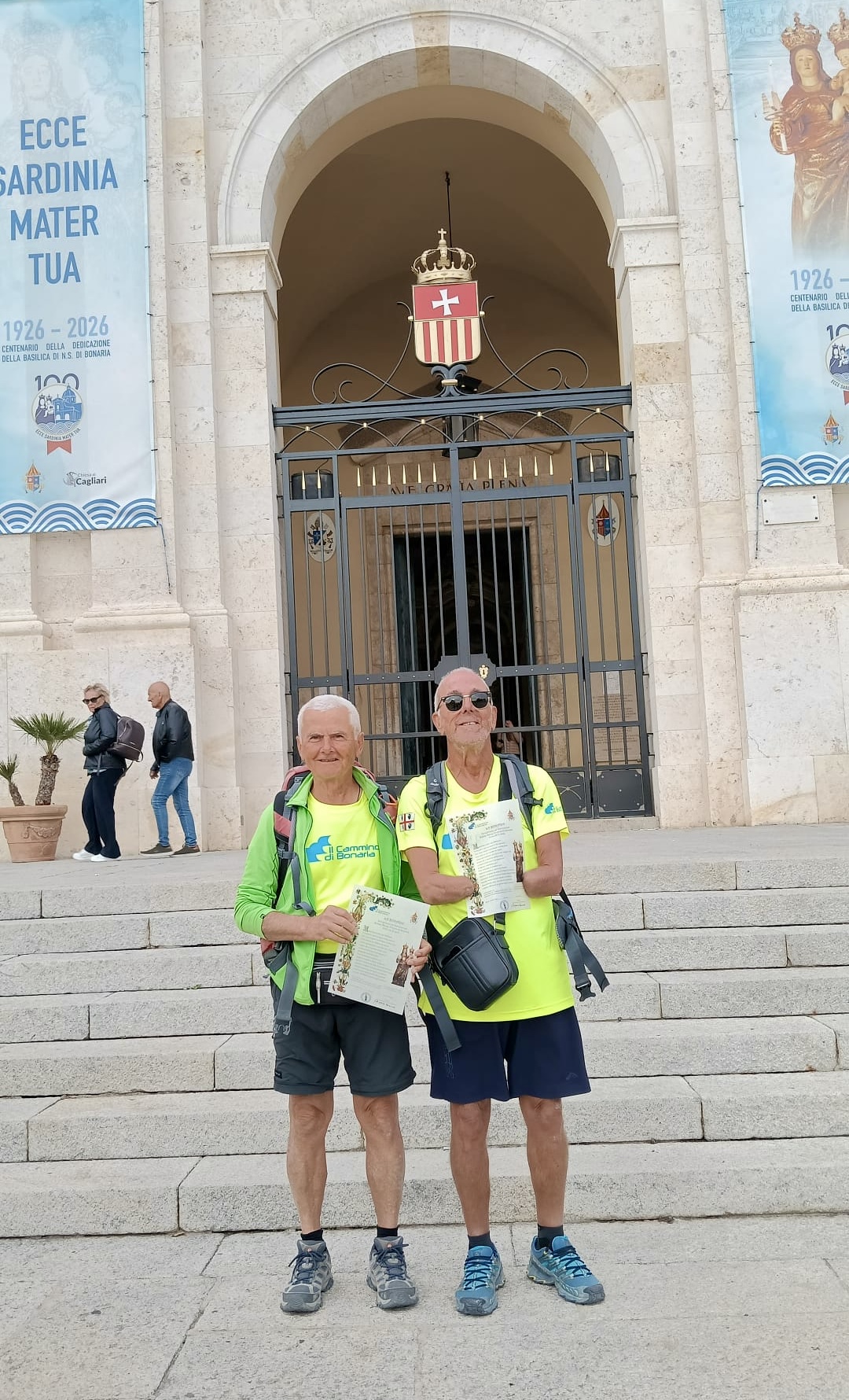
My close friend Raffaele was the first to tell me about the Bonaria Pilgrimage; being Sardinian and living in Sardinia, he is particularly devoted to Our Lady of Bonaria. A pilgrimage route that passes through the heart of the region was bound to pique my curiosity and interest. We talked about it, assessed its feasibility based on his abilities, and ultimately decided to set out. Raffaele and I had already walked the Camino de Santiago together last year—an extraordinary life experience.
A journey that exceeded my expectations. In terms of scenery, I was captivated by the expanses of Mediterranean scrub and the cork oak forests—from which the bark had recently been stripped—and Raffaele explained to me that it grows back quickly, in just a few years, along kilometers of road where I didn’t encounter a single soul. I particularly love solitary hikes, where you walk for kilometers surrounded by nature, where it feels as though you’re becoming one with nature and perceive it as a friend, a protector, and a source of energy. And the tinkling of bells from the flocks in the distance, sometimes hidden by thick shrubs. I really enjoyed the arbutus berries—beautiful, red, ripe, and juicy. And the prickly pears were still very good, even though I had to pay the price of a few thorns in my hands. I did my best to convey to Raffaele what I saw around me
But what struck me most were the people: I knew about the hospitality of the Sardinians, but what I experienced went far beyond what I had imagined. I encountered courtesy, kindness, willingness to help, and support—both in a practical sense and in the form of emotional, moral, and energetic encouragement: a silent, unspoken encouragement to keep going; everyone was with us. Not to mention the contacts, the organizers, and everyone involved with the pilgrimage—those we met in person or spoke with on the phone. I’d love to name and thank them one by one, but I won’t, for fear of leaving someone out.
Along the way, we encountered several obstacles that really put us to the test—sections that are perfectly normal and pose no problems for everyone else, but not for us: we came across sections of trail that were very uneven, stony, rocky, and full of steps; paths flanked by brambles where two people couldn’t walk side by side; we had to climb over fences using rickety, precarious ladders; there were dry-stone walls to scale. And now that we’ve finished the Bonaria hike, I sometimes wonder how we managed to overcome all those challenges and complete this beautiful, enjoyable adventure; and the only answer I can come up with is that, in those difficult moments, all the people we met were right there with us.
Luigi Visentin Ferrara

